Monday, 30 July 2018

C Bullock

Christopher Bullock
Born 18 November 1888 St Enoder, Cornwall    Killed in Action 4 October 1917 
Private 32375 1st Battalion East Lancashire Regiment
Commemorated on Tyne Cot Memorial


Christopher "Kit" Bullock - photograph courtesy of a family member

Christopher (known as Kit to his family) was the son of William Jeffrey Bullock and Mary Jane Blake.  William, the son of a miner, was a labourer in the china clay industry.  Christopher would follow him into this line of work.  

Mary Jane and William married in 1871.  They had the following children:

Edward John b. 1872 d. 1874
Mabel b. 1876 d.1965
Elizabeth Alberta b. 1878 d. 1895
Alfred b. 1885 d. 1956 (USA)
Arthur b. 1886 d. 1970 (USA)
John b. 1887 d. 1956
Christopher b. 1888 d. 1917
Evelina b. 1892 d. 1991

Evelina and Mabel are listed at the same address in Newquay on the 1939 Register.  Evelina had married, but Mabel remained a spinster.  Two brothers, Alfred and Arthur, emigrated to the USA prior to World War 1.

I can't find when Christopher joined the army.  His medal card shows that he was posted with the Middlesex Regiment, the Duke of Cornwall's Light Infantry, Somerset Light Infantry and the East Lancashire Regiment.  The 2 Battalion Middlesex Regiment and 1 Battalion DCLI were both part of 14th Brigade 5th Division, so Christopher may well have been reassigned.  He was then transferred to 11th Brigade 4th Division, with 1 Battalion SLI and 1 Battalion East Lancashire Regiment.

Christopher would have spent all his active service around Ypres and the Somme.  It is likely that he lost his life during the Battles of Ypres (3rd Ypres or Passchendaele) at the Battle of Broodseinde.


4th Division were with General Gough's Fifth Army.  The plan was to take Broodseinde Ridge and, at a great cost, this was achieved.  Heavy rain hampered the operation, turning the ground into a quagmire.

Christopher's body was not recovered for burial, but his sacrifice is commemorated on the Tyne Cot Memorial.


Sunday, 26 April 2015

H C Rickard

Henry Cecil Rickard
Born 9 June 1897 Brioude, France  Died of the Effects of Gas 26 August 1918
Corporal S/14862 1/5th Battalion Seaforth Highlanders 
Buried at Ligny St Flochel British Cemetery, Averdoingt


Henry Cecil Rickard, known as Cecil, was the youngest child of John Henry Rickard and Mary Annie Mitchell.  The couple had married in 1886 at the Wesleyan Chapel at Bolingey.  

John Rickard's job as a mining engineer took him to France, where all of the couple's six children were born. Sadly, two of the children died in infancy.  Cecil, along with his brothers, was sent back to Cornwall to be educated.  He attended Truro School and later obtained a first class certificate at the School of Metalliferous Mining in Camborne.  His brothers, Thomas and Rene, also took up careers in mining. 

Cecil enlisted on 5 July 1916.  With his mining background, he might have been expected to become a sapper; instead, he became a gas instructor with the Seaforth Highlanders at the Cromarty Naval Base.  In April 1918 Cecil was transferred to the 5th Battalion Seaforth Highlanders and was sent to the Western Front.  Despite his training, he was gassed on 27 May 1918 and spent some time recovering at Le Treport Hospital.  He wasn't alone; the Battalion diary records that 52 men were wounded or gassed around this time.

 By 8 August he was well enough to rejoin his regiment, but his time back in the trenches was short.  Once again, he was gassed, this time whilst holding the line at Arras. The War Diary for the 5th Seaforth Highlanders records for August 1918:

"On the 2Ist, the battalion again advanced and
captured another system of trenches. During this
period, our lines were heavily bombarded, principally
with gas shells, and gas casualties were severe, but
the advance continued steadily, and in six days'
fighting the Chemical Works, Roeux, Plouvain, and
Greenland Hill, a slightly rising piece of ground north-
east of the Chemical Works, were once again in British
hands. "

Cecil died at the 7th Casualty Clearing Station on 26 August 1918.  Around 117 other men were gassed during this period.   

Cecil's Commanding Officer wrote to Cecil's parents:
"I can't express my sorrow at the death of your son, one of the best NCOs of my company".

Cecil's brother Rene, shown right, also served in the army, happily returning from the war.  


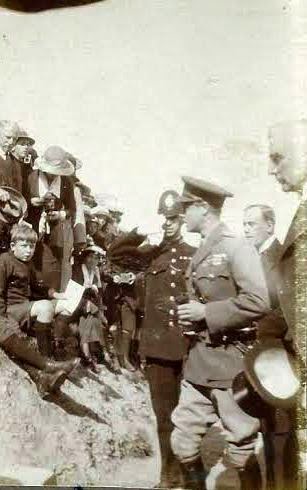
Mr and Mrs Rickard had bought a home in Newquay before the war - Mrs Rickard and her daughter Florence were recorded in Colchester Villas, Edgcumbe Avenue, on the 1911 Census - and continued to live there after the war.  Hopefully, they took some consolation in seeing Cecil's name on the new war memorial - the family have kindly shared these photographs of the ceremony dedicating the war memorial in 1921.  

As well as being remembered on the town's war memorial, Cecil's name is included on the Truro School memorial.  I've noticed that he is not mentioned by the Camborne School of Mines, so I shall get in touch with them.  The West Briton and Cornwall Advertiser carried a story on 19 Feburary 1920 about a service at the town's Wesleyan Church.  The "impressive" service was occasioned by the unveiling of a brass plaque paid for by Mr and Mrs Rickard in memory of Cecil.  In addition to Cecil's name, H A Bray, R H Clemo, C A Colmer, J H Ennor, C R Ennor, F Jewell, E Julian, T Luke, R Rawle, R Rowlatt, R and A Trebilcock were included on the plaque.  A collection of £7 was collected, which was donated to the Cottage Hospital fund.  


Mr Rickard died in 1941 and Mrs Rickard died 10 years later.  Their address at the time of their deaths was 5 Edgcumbe Avenue, Newquay. 


All the photographs in this blog have been kindly shared by Cecil's family and are used with their permission.  I am very grateful to them for their assistance and kindness.  

Sunday, 22 February 2015

J L Rogers

John Lewis Rogers
Born 1890 Truro  Died 15 November 1918 Cairo
Captain 1/4 Battalion Duke of Cornwall's Light Infantry
Buried Cairo War Cemetery


John was the son of china clay merchant Joseph Rogers and his wife Elizabeth Webber Salmon.  Joseph was born in Ireland, though he had moved to Cornwall at an early age.  The couple lived in Kenwyn, Truro.  

The couple had five children, of whom four survived:

Ruby Lillian (did not marry) (born 16 October 1883 - 1981)
Hazel  Salmon (married George Darel Senhouse Le Messurier) (born c 1885 - 1947)
Olive Mary (born c 1887)
John (born 1890 - 1918)


On the 1911 census, John is listed as a shipping clerk, boarding at a house in Blackheath.  His parents had by this time moved to Newquay, living at Bolowthas with two of their daughters and a couple of domestic servants.  

I can't find the date on which John joined up, but I have found a report in the West Briton and Cornwall Advertiser from 18 July 1912 in which he is mentioned.  The annual training of the Cornwall Territorials took place in Newquay and J L Rogers is listed among the Lieutenants of the 5th DCLI.

After war was declared, John's battalion was stationed during the war. The 1/4 left Truro in 1914 and sailed for India on 9 October 1914, arriving at Bombay on 10 November.  They remained in India for over a year, leaving early in 1916 and landing at Aden on 28 January.  After a year with the Aden Brigade, they travelled to Egypt, arriving on 13 February 1917.  John is mentioned in the DCLI History on 9 April 1918.  He was taking part in an action against the Turks in Palestine, near Ballut Village, commanding A Company.  Along with another company, his men were occupying a ridge and came under heavy fire with the result of 17 men losing their lives and 46 being wounded.  

The 1/4 DCLI were last in action on 31 October 1918.  Sadly, having safely come through several battles, John lost his life due to pneumonia on 15 November 1918. 

John's parents erected a memorial to him at St Columb Minor Church, which also lists the other men who fell during the Great War.  

During his war service John kept a personal war diary, which is kept at the Imperial War Museum.  


Friday, 20 February 2015

1000 Speak for Compassion: Compassion in the Trenches

Was the War a Compassion-Free Zone?

I’m taking part in a global initiative called 1,000 Voices for Compassion.  Today, bloggers all over the world are writing posts about compassion.  I was slightly at a loss when my good friend Yvonne mentioned her idea – wonderful though it is, it doesn’t seem to fit comfortably with military history.  I thought I might have to give it a miss, until I read the Pope’s Lenten message.  There, he referred to the globalisation of indifference, a state in which we are often so caught up in our internal world that compassion gets left behind.   It led me to wonder what happens to compassion when we are caught up in the horrors of our external world; when there’s a war, for instance.

Compassion:  It's Not Just for Christmas

Artist's Impression of the Christmas Truce 1914
Source:  Wikimedia, Public Domain

Amid all the carnage of the Great War, it’s tempting to think that compassion was blown away, shattered like the tree stumps on the Western Front.  The narrative that we have received supports this idea.  War poets like Wilfred Owen recounted their experiences in words dripping with pain and bitterness; films dwell on the drama and gore.  But in those four years did stiff upper lips replace kind hearts; did cynicism overtake kindness; was compassion overtaken by duty?

My feeling is no, compassion did not wither away.  It was alive and well, although it was sometimes forgotten in the everyday routine of life, just as it so often is today.  I’ve not undertaken any great research on this, it’s just my opinion, based on snippets of information I’ve read over the years.  Some of it’s in the public domain, some of it is amongst my family’s papers. 

One of the most iconic moments of the war was rooted in compassion:  the Christmas Truce and football match of 1914.  The men on the ground left their trenches and met in no man’s land to fraternise, celebrating peace and exchanging small tokens.  No hate, no rancour, just care and empathy for their fellow men.  Over all too soon, but a glimmer of compassion in the midst of the mud.

Greater Love Hath No Man

The Noel Chavasse Memorial
By Gaius Cornelius (Own work) [CC BY-SA 3.0, via Wikimedia Commons

In the panic and chaos of the trenches, compassion could go unnoticed, but occasionally it was seen and rewarded.  The Victoria Cross is awarded to military personnel who display bravery, valour or self-sacrifice in the face of the enemy.  Often, the men who received the award during World War 1, did so because they were attempting to rescue wounded comrades.  628 VCs were awarded during the war to 627 men.  Captain Noel Chavasse VC received the award twice.  Captain Chavasse, a doctor with the RAMC was first awarded a VC for his action in recovering and treating the wounded whilst under heavy fire at Guillemont on 9 August 1916.  He received his bar (second award) for refusing to leave his post for two days, despite being wounded, and assisted in not only treating men, but carrying them to safety whilst again under heavy fire.  He was to die of his own wounds shortly thereafter. 

I can think of no greater compassion than to ignore the risk to one’s own life in pursuit of the safety of another’s.  Men awarded VCs, like Captain Chavasse, are not the only ones to have risked themselves.  Many unarmed stretcher bearers laboured in the mire of no man’s land to recover their comrades and bring them to safety.

Uncommon Kindness for the Common Man

Combat on the front line produced its heroes, but away from the action there were everyday deeds of kindness too.  My great-uncle Sidney was wounded early in 1917.  Somehow, someone got word to one of his brothers.  Edwin was stationed, I believe, at a hospital far away from Sidney, where he worked with St John Ambulance.  There must have been thousands of men wounded at that time, but rather than treating this family crisis as a commonplace occurrence that must be endured, Edwin’s superior officers organised a train ticket and gave him leave to visit his brother.  Despite a frantic dash across France, he arrived “too late to see the last of Dear Sidney”, assuring his parents in his letter home that the hospital staff were kind and sent condolences.  Edwin stayed overnight with an NCO who gladly offered to share his quarters.  The next day, Edwin bought flowers for the funeral and again was treated kindly by the military and hospital staff.  Back at his own hospital, he was met with condolences and recognition of the pain of his loss from comrades and superiors alike. 

It seems to me that there was plenty of compassion in the war, and not just the great acts of bravery and heroism, but small, simple gestures that made life slightly more bearable in a time that could have become all too unbearable.  Today, as the Pope said, we are in danger of becoming indifferent to our neighbours and losing our compassion for our fellow beings.  Yet, if these soldiers, medics and nurses could show compassion in the midst of all the suffering around them, never losing sight of their humanity, we can too.  More good reason to say:


Lest we Forget


Thursday, 19 February 2015

S Brown

Samuel Brown
Born circa 1878 in Perranzabuloe  Killed in Action 15 July 1916
Buried at Mazingarbe Communal Cemetery Extension, Pas de Calais, France
Sapper 98226 155th Field Company, Royal Engineers
Enlisted Newquay 9 May 1915


Samuel was the son of a copper miner, Samuel, and his wife Elizabeth Pascoe.  The couple had another son, William, who was born two years before Samuel.  Samuel was baptized on 28 November 1878.  His parents are listed as residents of Bolingey.

Elizabeth was the daughter of surgeon Richard Pascoe, himself the son of a surgeon.  By the 1870s the Pascoes were living in Perranzabuloe, where presumably Elizabeth met Samuel Brown Snr.  The couple were married on 4 July 1876, the 22 year old groom stating that his occupation, like that of his father William's, was a miner.  21 year old Elizabeth gave her father's occupation as "Gentleman".  Her sister Emmeline was a witness.

Elizabeth and Samuel do not appear to have enjoyed a long married life.  Elizabeth is shown as widowed on the 1891 census.  She went  on to marry Samuel Kitto, a miner, and she and her two sons were living with him in Newquay by 1901.  Elizabeth's sister, Emmeline, married Samuel Kitto's son, Jonathan.

Samuel Brown is listed as a joiner on the 1901 census.  He married on 5 October 1908, to 21 year old Maud Elizabeth Carter, whose father James was a Newquay fisherman.  The couple were living in Commercial Square by 1911, where Samuel had his own business as a tobacconist.  Their son, William Kenneth, had been born on 9 November 1909.

Part of Samuel's service record exists and shows that he joined up on 9 May 1915.  He stated that his occupation was a carpenter and joiner.  His number of dependents had increased, a second son, Cyril Owen having been born in November 1913.  Samuel left for France on 18 December 1915.  The entry on his record detailing his death is indistinct.

After he enlisted Samuel went to the Royal Engineers and became a sapper, the RE's equivalent of a private.  155th Field Company were part of the 16th (Irish) Division and arrived in France in December 1915.  Samuel was killed before their first major battle, at Guillemont, a phase of the Battles of the Somme.  The 16th (Irish) Division were concentrated around the Bethune area until they moved up to the front in September 1916.  Samuel is buried in the cemetery extension that the Division opened in April 1916 for their war dead.

Both of Samuel's sons appear to have passed away in the early 1980s.  Maud does not seem to have remarried and lived until the mid 1960s.


Mazingarbe Cemetery Extension
By Wernervc (Own work) [CC BY-SA 4.0 (http://creativecommons.org/licenses/by-sa/4.0)], via Wikimedia Commons


Wednesday, 18 February 2015

K C Campbell

Kenneth Gordon Campbell
12 February 1895, Cambridge  Killed in Action 25 September 1915
Buried at Dud Corner Cemetery, Loos
Lieutenant 12th Battalion Highland Light Infantry

Kenneth died at the age of 20


The inscription on the war memorial is incorrect; the initial "C" should be a "G".  

Kenneth Campbell is connected to Newquay as he and his parents - Frederick Gordon (a barrister) and Blanche Campbell - came to the town for holidays.  Eventually his parents bought a house here, overlooking the golf course and Kenneth became quite proficient at the game.  They appear to have moved away shortly after the war.

I'm not going to write any more about Kenneth, since I've found two excellent articles already written about him and they cover all the bases, so I shall link to them.  

Winchester College article about their former student.

A very comprehensive article about Kenneth and his family on the Mill Road Cemetery website.


Friday, 8 August 2014

B A Pollard

Bertram Alfred Pollard
Born circa 1874, in London?   Killed in Action 13 October 1915 
Buried at Spoilbank Cemetery, Nr Ypres
Company Sergeant Major 3/6084 6th Btn Duke of Cornwall's Light Infantry


The earliest census return for Bertie is 1881.  Aged 6, he is living in Penzance with 64 year old Elizabeth Wallis, a retired general servant.  She is the head of the household, his relationship to her is "boarder.  His birthplace is stated as Banbury, Oxfordshire.  Ten years later, he is still a boarder with Ms Wallis, though he is now said to have been born in London.  On his army records he said he had been born in Penzance and at one time he lists an "E Wallis" in Penzance as his next of kin, stating that she is his aunt.  There is a Bertram Alfred Pollard recorded as born in Kensington, London in the last quarter of 1874, so perhaps this is Bertie.

His parents are conspicuous by their absence.  On his CWGC records it states that his parents are Mr and Mrs Alfred Pollard of Penzance, though I've not found any other record of them.

Bertie, a harness maker, enlisted with the regular army on 5 June 1893, having already joined the Duke of Cornwall's Light Infantry militia .  On 2 June 1873 he had been examined at Bodmin.  He was 5 feet 4 1/2 inches tall, weighed 116 pounds and had a chest measurement of 32 inches - 34 1/2 inches when expanded.  His complexion was sallow, his hair dark brown and his eyes blue.  The examining doctor was unimpressed and considered him unfit due to his chest measurement.  Three days later, a captain declared him fit and Bertie embarked on a long career with the Army with the 2nd Battlion DCLI.  His records show his service at home and abroad as follows:

5 June 1893 - 9 Dec 1894         UK
10 Dec 1894 - 20 Feb 1900      India
21 Feb 1900 - 17 Aug 1901      Ceylon
18 Aug 1901 - 7 June 1905      Home
8 June 1905 - 2 Sept 1907        Gibraltar
3 Sept 1907 - 19 Jan 1910      Bermuda
20 Jan 1910 - 10 Mar 1913    South Africa
11 Mar 1913 - 4 June 1914   Home

On 28 April 1905, Bertie married Alice Ann Jones in Penzance.  

 His discharge came on 4 June 1914, just two months before the outbreak of the Great War.  He and Alice must have found a home in Newquay, as the town is given as his place of residence on the casualty records.  He re-enlisted at Bodmin and was posted not to his previous Battalion, but to the 6th Battalion.

Bertie's medal card shows that he was in France by 21 May 1915.  

The history of the Duke of Cornwall's Light Infantry gives no details of the incident in which Bertie was killed; in fact, it simply states that for the final three months of 1915 in Ypres, nothing of great note happened to the 6th DCLI. 

British wounded being evacuated from Ypres
By Rogers, Gilbert (MBE) [Public domain], via Wikimedia Commons

Bertie is buried with three other men of his battalion who fell on 8, 9 and 11 October.

Alice had his gravestone inscribed with the words  "In fondest remembrance RIP".  She appears to have moved back to her native Wales, dying in Cardiff in 1949.  She and Bertie do not appear to have had any children.


Wednesday, 6 August 2014

F H Passmore

Frederick Herbert Passmore
Born 1888 in Plaistow, London  Killed in Action 1 May 1918
Buried Nine Elms British Cemetery, Belgium
Lance Corporal 80803 Royal Army Medical Corps  Enlisted Newquay 30 October 1915


Frederick was the son of Frederick Thomas Passmore and Florence Louisa Parr.  The couple married in 1882 in Bristol.  Frederick Snr was a pastor, working as a city missionary in London during his son's childhood.

The couple had four children, one of whom died in infancy.  The three surviving children were:

Edith Miriam b. 1884
Frederick Herbert
Dorothy Winifred b. 1900

By 1911, Mrs Passmore and Dorothy were living in Golf Terrace, Newquay.  Frederick Senior was visiting in Devon at the time of the census.  Frederick Herbert had found work in Bristol as an assistant chemist.  He must have moved back to Newquay by 1915 since that was the year he made two important decisions and both record him as living in Newquay.

Frederick had met Helena Maud Irons, a young woman born, like him, in 1888.  Helena was the daughter of George and Eliza Irons, her father making his living as a master mariner.  Helena worked as a shop assistant and lived with her parents at Alma Place.  On 30 October 1915 Frederick and Helena married in the town and, on the same day, Frederick enlisted in the Royal Army Medical Corps.

Very little of Frederick's service records survive.  They do tell us that he was a small man, just 5 feet 3 1/2 inches tall, with a 33 1/2 inch chest.  The RAMC was probably delighted to have him; he was a registered dispenser and his records show that he passed his first aid course earning him an increment on the pay scale.  He was posted abroad on 31 July 1916.  No doubt he was needed, that being the first day of the Battle of the Somme.

Frederick's record shows that he was promoted to Lance Corporal on 27 December 1917.  This is confirmed by the Commonwealth Graves Commission Registration Reports, but he is shown as a Private on both the Roll of Honour and his gravestone.

The CWGC Registration Report shows that four other men of the 75th Field Ambulance died alongside Frederick on 1st May 1918.

His widow asked that his gravestone be inscribed with the words "The blood of Jesus Christ his son cleanseth us of all sin".

Helena appears not to have remarried and lived until 1968.


Tuesday, 5 August 2014

The Lamps Went Out


Yesterday marked the centenary of Britain's entry into the Great War.  Sir Edward Grey, the Foreign Secretary, famously remarked on the eve of war that "The lamps are going out all over Europe and we shall not see them lit again in our life-time".  The British Legion adopted the quote to inspire their Lights Out campaign which called on the British public to turn off their lights, bar one, between 10 and 11 pm to remember the outbreak of war.

I decided that there was only one place for me during Lights Out:  the war memorial.  I set off with a candle, a makeshift lantern and a lighter and was at the war memorial just before 10 pm.  My first problem was the wind.  My plan was to set a candle above the plaque, making it visible from town.  Unfortunately, the wind was blowing too hard to allow the candle to stay alight, so I had to move it around to the other side of the memorial, facing out to sea.  Hopefully, some fishermen spotted it

For the first half-hour or so, I was on my own.  Then I heard the crunching of gravel and two other women arrived.  They set up candles too and we stood and swapped stories.  A rain shower passed over, but we kept vigil.  Just before 11 pm we were joined by a gentleman who had been watching the centenary events on television and had felt moved to get in his car and drive up to the war memorial.

At just about 11 pm it started to pour with rain, which seemed appropriate.  We stayed for a few minutes more and then packed up our candles and left. 89 men of Newquay, and family members, remembered on the centenary and always.


Saturday, 19 July 2014

W A Coom

William Alfred Coom
Baptised 29 January 1888, St Austell  Died of Wounds 21 April 1917
Private 1170 17 Battalion D Company Australian Imperial Force
Enlisted 2 February 1915 at Liverpool, New South Wales, Australia
Buried at Grevillers British Cemetery, France


William was the son of Alfred Coom, a gardener, and his wife Emily Luke. Emily was the daughter of William Luke, a tinker from Dulverton in Somerset, who had settled in the West Hill area of St Austell.  The couple married in St Austell on 30 October 1885 and lived in St Austell, Roche and, by 1911, were living at Windsor Cottages off Berry Road in Newquay.  

 In the 1911 Census return Mrs Coom states that she had 10 children, 5 of whom were still living.  I've not found all of their names, but as best I can tell, here are 7 of them:

Lillian Maud born 1886
William Alfred 
Edith Gladys born 1889
Maud Mary  born 1891
Thomas Henry 1892 - 1972
Gladys Mary born 1893
Reginald born 1894 (died as an infant)
Reginald born 1898 

I can't find an emigration date for William, but he evidently left for Australia and found work as a station hand.  He enlisted in early 1915 and was soon aboard SS Themistocles bound for Gallipoli.  He soon ran foul of the army; he was caught sleeping at his post on 12 September  and sentenced to Field Punishment No. 2.  for a period of 28 days.  Before the 28 days were up, he was in hospital suffering the effects of dysentery.  A bout of enteric fever (typhoid) followed and William was sent to Graylingwell War Hospital, Chichester by the end of the October.  He was back at a base in London for a couple of months, where he was docked pay for a deficiency of kit.  In August 1916 he was in France.

17th Battalion waiting for troop trains in Italy 1915
By photographer not identified [Public domain], via Wikimedia Commons


William had several more hospital visits, for scabies, trench foot and boils.  His final visit came after he was wounded in action on 19 April 1917.  He had gunshot wounds in his foot and abdomen.  He died on 21 April 1917.  William was killed during the Battle of Arras, which lasted from 9 April to 16 May 1917.  The Unit's War Diary does not make any mention of casualties on 19 April, though there are many reported a few days earlier on 15 April.  What is certain, is that the Australians were heavily outnumbered but managed to inflict more casualties than they sustained.

Back in England, Alfred never knew his son's fate; he died a month before war was declared.  Emily seems to have lived through another war, dying in 1947.  William's brother Thomas found a job with the Post Office and worked in Newquay.  


On a personal note, one of my great-uncles, Ernest, was also with the 17th Battlion (A company) and travelled out to Gallipoli on the same troop ship as William.  Ernest and  one of his brothers, Reginald, had moved to Australia to live with my great-grandmother's brother, who was the foreman of the goods yard at Sydney Railway Station.  So, William may possibly have bumped into my great-uncle on board the ship, or my great-great uncle through his work as a station hand.  


Sunday, 13 July 2014

Louisa Tearle

Today's post is a little different, in that the subject is not listed on the Newquay War Memorial.  You can, however, find her war grave in the town's cemetery on Crantock Street.

Louisa Tearle (Nee Lees)
Born 1878 Lambeth, London  Killed by Enemy Action 28 March 1915 Bristol Channel
Stewardess/Purser SS Falaba


Louisa was the daughter of Arthur and Emma Lees (nee Farnham).  She had a brother, George Farnham Lees, who may have emigrated to Canada sometime after 1911.

In 1902 Louisa married Henry James Tearle, who worked for the Elder shipping line.  The couple had five or possibly six children:

Arthur James 1902 - 1979
Ernest Henry b 1905
Gertrude Louisa 1906 - 1987
Frank George b 1909
Donald Stanley 1910 - 1984

There is also reference on some sites to a brother named Ivor who died at the age of 16, although I have not been able to find any records for him.

Henry Tearle was killed in Lagos, Nigeria in 1914, in unknown circumstances.  Louisa, who may already have worked for the Elder Line, went to sea as a purser according to some accounts, although she is listed as a stewardess.  

The SS Falaba set off from Liverpool for Sierra Leone with 95 crew and 147 passengers. After leaving Merseyside on Saturday, 27 March, she met U-28, captained by Baron Siegfried Von Forstner in the Bristol Channel.  The U boat gave the Falaba 10 minutes to dismantle her wireless equipment and abandon ship.  According to the Germans, the crew of the Falaba used this time to try to contact the Royal Navy with the position of the U boat.  They then allowed a further 10 minutes for the lifeboats to be launched before firing.  The British claimed that they were given only 10 minutes and were then fired upon, the Germans laughing at survivors as they struggled to get aboard lifeboats.  The Germans refuted this, claiming that they were in fact moved to tears to see lifeboats being overturned in the rough sea.

The ship went down rapidly and although the lifeboats were launched, 104 people perished (57 passengers and 47 crew).  One of those who lost his life was an American, Leon Chester Thrasher.  His death almost sparked the entry of the US into the war, but assurances that the captain of the Falaba had been given adequate time to launch the lifeboats and a suggestion that she carried contraband explosives allowed the US to back off from war - until the sinking of the Lusitania.

Louisa's body must have been recovered by a Newquay boat, although I've not found when she was brought ashore.  Her children were now orphans.  Gertrude, who was partially sighted, became a successful teacher working in both the UK and Australia.  Her youngest brother Donald was adopted by an aunt who emigrated to Australia in 1925. He became a miner and enlisted with the Australian Army  in 1939.  He was taken as a Prisoner of War in 1941 and interned until the end of the war.  He was later granted the Military Medal for bravery.

On Donald's records he listed his next of kin as his brother, A J Tearle, HMS Rosemary, Portsmouth.  I can find no other information on Louisa's other children, particularly "Ivor" who is mentioned as being an inspiration to Gertrude and who was apparently, like her, partially sighted.

There is a copy of the British inquiry into the sinking of the SS Falaba here.


Saturday, 12 July 2014

C E Ditton

Charles Edward Ditton
Born in March 1888, Truro, Cornwall   Killed in Action 16 October 1918 near Heule, Belgium
Lance Corporal  43387 Royal Irish Fusiliers  9th (North Irish Horse) Battaliohn
Formerly with 1/9 London Regiment


Charles was born in Truro in March 1888. He was baptised at St Paul's, Truro, on 24 April 1888.  He was the second son of Frederick Ditton and Edith Jewell.  The couple had 14 children in all:

Ethel 1884 - 1915?
Lillian 1885 - 1952
Frederick James 1887
Charles Edward
Sidney Jewell 1889 - 1959
Clara Gwendoline 1891 - 1990
Edith Mary 1893 - 1977
Florence Gertrude Helena 1895 - 1984
Harry Jewell 1897 - 1984
Dorothy May 1898 - 1984
Frances Anna 1900 - 1960
Marion Grace 1902 - 1998
Kathleen Marjorie 1905- 1954
Phyllis Monica 1908 - 2005
 (Approximate dates)


Frederick, a native of Brixton, London, was a grocer, as was his Cornish mother, Eliza Lukes.  Edith was the daughter of farmer James Jewell and his wife Ann.  She was born at St Erme.  The couple married on 27 May 1883 at St Paul's, Truro.  

Curiously, Frederick's widowed mother, Eliza Lukes Ditton, married Frederick's widowed future father-in-law, James Jewell, in 1881.  Even more curiously, James had been married to Anna Lukes, Eliza's sister.  She was therefore Edith's aunt by blood and became her step-mother, as well as her mother-in-law!

Frederick died in 1909, leaving Edith to bring up the younger children on her own.  

By 1911, Charles and his brother Frederick had moved to London to work for Cook, Son & Co., at that time the country's largest wholesale clothing company.  Both men were living at the company's hostel for their commercial travellers.  They would have travelled the country by rail with samples of their employer's merchandise.  

Charles joined the London Regiment as a rifleman in 1915.  In  November 1916 he was discharged so that he could join the Royal Irish Fusiliers.  This was also the year in which he married Nora Lucinda Pemberton Stevens, a school teacher from Penzance.  The couple had no children.

In May 1917, Charles fell "dangerously ill" - a telegram to this effect was sent to his wife, and a further letter advised her that permission to visit her husband  (suffering lumbar pneumonia) at the hospital in Boulognecould not be granted.  The Lance Corporal rallied and was well enough to have a furlough from 29 August to 7 September 1917 which he spent with his wife at "Delafosse", Tower Road, Newquay.

According to the unit's war diary, The Royal Irish Fusiliers were at Dadizeele at the beginning of October 1918.  On 4 October they relieved the 9th Royal Inniskilling Rifles at Hill 41.  They had 13 officers and 390 other ranks.  By the 7 October, it was noted that the enemy were cutting wire at night in preparation for an attack.  A raid was carried out by the Royal Irish on 11 October and 14 prisoners were captured and 10 enemy soldiers killed, losing 6 men themselves when the enemy counter-attacked.  They then went into reserve.  Back in the line by 14 October, the 9 Battalion joined the Battle of Courtrai.  

The Battalion's principle objective was to attack, capture and hold the crossing over the River Lys.  The advance started at 5.35am.  The Royal Engineers knocked out the bridges and by 6pm the last of the Battalion withdrew.  One man of the Battalion was killed that day:  Charles Ditton.

Nora stayed in Newquay after the war, along with her mother Lucy and two of her sisters. Her War Widow Pension was sent at first to 50 Tower Road; she was awarded 13 shillings 9d a week.  Later she lived at Arlington House on Berry Road.  Nora did not remarry and died on 9 May 1945, leaving her sisters £4,170 in her will.


Sunday, 15 June 2014

C A Colmer

Arthur Cecil Colmer
Born in 1893 in London.  Killed in Action 1 July 1916 in France
2nd Lieutenant Royal Field Artillery "A" Battery, 96th Brigade
Buried at Dartmoor Cemetery Becordel-Becourt


Arthur was the son of Arthur May Colmer and Anna Letitia Pateson.  Arthur and Anna married on 9 January 1892 in Great Queen Street Chapel.  Arthur's father was recorded as Oliver Colmer, a draper, whilst Anna's father, Reuben, was a toy importer.  The bridegroom, a native of Liskeard, listed his profession as "warehouseman", though he would go on to be a draper like his father.

The Colmers moved back to Liskeard sometime around 1895 and Arthur Snr set up shop as a tailor and outfitter on Pike Street.  By 1911, at the age of 43, Arthur had retired and was living in Looe. 18 year old Cecil (it's possible that the family called him Cecil rather than Arthur, so that's how I'm referring to him here) had followed his father into the drapery trade and was a tailor cutter working on his own account.  The family was completed by 16 year old Dorothy and Anna's sister Elizabeth who, like their father, was a toy importer.

Between 1911 and 1914 Cecil moved to Newquay and lived at "Hannafore" on Headland Road.

Cecil joined up fairly quickly on the outbreak of war.  He was posted to the Duke of Cornwall's Light Infantry and his medal card notes that he entered the theatre of war on 14 November 1914 (thus earning him a 1914 Star).  From the Cornwalls he moved to the Royal Engineers as a corporal, then went to the Royal Horse Artillery & Field Artillery as a Second Lieutenant on 10 September 1915.

Cecil was killed on the first day of the Battle of Albert, which formed part of the Battle of the Somme.  His battery would have been part of the bombardment of enemy lines on the days leading up to 1 July, the hope being that the shelling would leave the way clear for the infantry to advance unchallenged.  In the event this didn't happen.  The Germans were in their bunkers and emerged with their machine guns to pick off the British as they advanced.  More than 57,000 men fell, either wounded or killed, on that first day, 23 year old Cecil among them.

Cecil's sister, Dorothy, was the executrix of his will, in which he left £258 9s 3d.  Arthur and Anna retired to Bournemouth. Dorothy married, had four children and passed away just short of her 100th birthday in 1993.


Friday, 26 July 2013

Joseph James Sweet

Joseph James Sweet
Born 1894 in St Columb, Cornwall.  Died 29 October 1918 51st Stationery Hospital, Italy
Driver T/3/028659 Army Service Corps, No. 2 Aux. Pack Train


Joseph was born towards the end of 1894.  His parents were Samuel Sweet and Mary Grace Morris. The couple had married in 1891.  Samuel was the son of St Allen Parish Clerk, Henry Sweet.  

Samuel and Mary had three children:

William Henry (1892 - 1961?)
Joseph James (1894 - 1918)
Dorothy (1899 - ? )

Mary Sweet died in 1900, aged about 28.  Samuel had help in bringing up his children from his sisters Bessie and Clara.

In 1904 Samuel married Mary Annie Williams.  The couple had a daughter, Hilda Esther, around 1905.

Samuel died on 13 April 1907 leaving his widow with £190 17s 6d.  After their father's death, William and Dorothy seem to have moved to live with their aunt Bessie at Carn Brea.  William worked with her husband in the tin mines.  Joseph stayed with his step-mother and step-sister on the farm; his uncle William Sweet was also living there.  Like his father, Joseph became a horse trainer.

On 26 October 1914, 20 year old Joseph (who may well have been known as James) married 18 year old Millicent Benson Trethewey from Fern Pit, East Pentire in Newquay.  The couple set up in lodgings with a Mrs Leary on St John's Road in Newquay. They didn't have long to enjoy married life; Joseph joined up on 13 November 1914.  The couple had apparently been courting for a while; their daughter Dorothy was born on 23 March 1915.

Joseph was sent to the Army Service Corps, not surprisingly as a driver.  His skill as a horse trainer would have been invaluable in driving a team of horses.  Joseph's medical records show that he was a small man, just short of 5'6", weighing 126 lbs.  His health was described as good.

On 3 August 1915 Joseph left Southampton, arriving at Le Havre the following day.  He was appointed an acting Lance Corporal on 3 October 1915.  He had a week's leave in March 1916 and received a Good Conduct badge later in the same year.  In July 1917 Joseph received some cuts to his arms and face whilst attending to his horses which his commanding officer recorded was not Joseph's fault.  

Joseph was taken to the 39 Casualty Clearing Station on 19 October 1918 complaining of a headache and pain.  It was noted that he his tongue looked "dirty".  He was transferred to the 51st Stationery Hospital on 21 October.  He had chest pain, a cough and looked debilitated.  The doctor noted that he was "very ill".  On 24 October he had a temperature of over 100, which dropped back slightly the next day.  However, it remained high for several days, his pulse becoming rapid and feeble.  He was given four hourly doses of brandy and also oxygen.  It was in vain; Joseph died at 5.30am on 29 October 1918, a victim of influenza.

Millicent seems to have married again a year after Joseph's death, and again in 1946 after her second husband's death in 1944.  Her second marriage produced three sons.  She died in 1985.  Her daughter with Joseph, Dorothy, doesn't seem to have married and died in the same year as her mother.


R G Rawle

Reginald Garland Rawle
Born 1896 in Newquay, Cornwall, Killed in Action 23 November 1917 at Cambrai
Lance Corporal 202010 7th Battalion DCLI
Commemorated at Cambrai Memorial, Louverval, France


Reginald was the eldest son of Lewis Garland Rawle and Mary Brenton Trembath.  The couple had married on 23 December 1893.  Lewis was a carpenter living in Newquay, Mary was a spinster living at Shop.  Both were 23 years old.  

By 1901 the Rawles were living at 8 Belmont Place.  A few doors away lived John Jacka, another carpenter, whose son Sydney was the same age as Reginald.  Both boys would lose their lives during the Great War.

The couple had seven children:

Reginald Garland
Florence Mabel  (17 Jan 1897 - 1979)
Gwendoline Violet  (1899 - 1935)
Robert Garland  (1901 - 1953)
Lewis Edgar  (7 Feb1902 - 1971)
Edna Mary  (15 Sept 1907 - 1972)
Dorothy May  (5 Dec 1908 - 1985)

In 1911, the Census recorded that Reginald was working as a Golf Caddy.  His sister Florence was a shop girl.

I can't find when Reginald joined the Cornwalls.  However, by 1917 he was with them in the front line at Cambrai.  The Battle of Cambrai was a British offensive, designed to surprise the enemy.  The 7th Cornwalls  relieved the 13th Green Howards in the front line trenches on 4 October 1917.  They were relieved on 16 October and then moved back to Bray a week or so later, possibly for training with the tanks which were to be used in the upcoming offensive.  On 18 November, the Battalion was again in the front line and endured a few days of heavy rain awaiting the onset of the Battle of Cambrai.

The Battle of Cambrai was a British offensive, which began at dawn on 20 November.  The Cornwalls would have left the trenches behind the wire-cutting tanks and alongside the fighting tanks.  A and B companies were successful in capturing their objectives, but C and D companies were hindered by problems with the tanks.  Despite this, the Cornwalls managed to capture around 150 Germans and kill another 50.  Their own losses were 61 wounded, 10 killed and 8 missing.  Following the first day of battle, the Cornwalls were dispersed in support.

By the 23 November, the weather was fine.  There was shell-fire from the Germans, but apparently no one was hit.  However, a barn in which some of the men were occupying was hit by three shells causing an evacuation.  There is no mention of anyone being killed, but perhaps this was where Reginald died.


Sunday, 6 January 2013

R C Rowett

Richard Cardell Rowett
Born 1900 in Portugal  Killed in Action 23 August 1918
Pte 85297 1/4 Battalion Royal Fusiliers (City of London Regiment) (Previous DCLI)
Buried Bucquoy Road Cemetery, Ficheux


Richard was the son of Charles Rowett and Florence Annie Pengilly.  Charles and Florence married at Redruth in 1893.  Charles was a mine engineer whose work took him abroad to Portugal and South America.  Several of the couple's children, including Richard, were born in Portugal.  Florence must have made friends in Portugal as she continued to travel back to the country after her husband's death.  The Rowetts had seven children, five of whom survived infancy:

Florence Kathleen (1895 - 1964)  Florence was left in Cornwall with her maternal grandparents in 1901 while the rest of the family were in Portugal.  Her grandfather Charles Pengilly was an arsenic manufacturer and preacher. 
Charles Edward (1899 - ?)
Richard Cardell
John Ernest (1901- 1972)
James Stanley (1903 - ?)

The three youngest boys were all born in Portugal.  In 1911 Florence and the five children were living in Scorrier.  Charles shows up on immigration records as arriving back in the UK from South America in late 1914.  He died soon after, aged 44, on 1 March 1915 . His probate records give his address as 1, Colchester Villas, Newquay and his occupation as mine engineer.  Florence was left £200.  She later moved to 43 St John's Road.

Richard joined the DCLI at Truro.  He was posted to the 1/4th (City of London) Battalion (Royal Fusiliers). The 1/4th were part of 56th (London) Division and Richard would have joined them at the Third Battle of Albert between 21 and 23 August 1918 (a phase of the Second Battles of the Somme).  The 1st DCLI were also at the Battle and the Regiment history notes that Friday, 23 August was an exceedingly hot day.  It was also exactly four years since the British first met the Germans at the Battle of Mons. 

The British offensives in the summer of 1918 marked the beginning of the end for the Germans.  Sadly, there were still many casualties, including Richard, in the final months of the war.  Richard is buried at the Bucquoy Road Cemetery.


Monument to the Royal Fusiliers in WW1 at Holborn in London
Wikimedia - Public Domain


Saturday, 5 January 2013

W J Oxman

William James Oxman
Born c 1891 in Newquay  Died of Wounds 16 October 1917
Pte 14185 5th Battalion Dorsetshire Regiment (Previously Devonshire Regiment)
Buried in Mendinghem Military Cemetery, Belgium


William James, who was sometimes known as James, was the son of William and Lavinia Glanville.  The elder William was a coachman, then became a fish hawker, whilst Lavinia was a charwoman. Lavinia (or Levinia) was the illegitimate daughter of Jane Glanville, a field labourer and washerwoman, who had a great number of children born out of wedlock.  Jane and several of her children spent some time in the workhouse at St Columb Major.  

William and Lavinia were married in 1875 and had the following children:

  • Thomas Henry (1878 - 1880)
  • Thomas Henry (1880 - 1959)
  • Lavinia "Janie" (1882 - ?)
  • Clarice Adelaide (1884 - ?) Worked cleaning train carriages during the war
  • (Agnes) Maud (1887 - 1960)
  • William James 
In 1911, young William had a job as a grocery storeman.  He was living at home with his parents, which was at 1 Norman Court.  The family had a lodger; Frederick Wills, a carriage cleaner with the GWR.  Perhaps Clarice Oxman got his job when he went away to war (Frederick married in 1913, went to war with the the Royal Engineers Railway Operating Division and died in 1955.  Clarice's employment as a carriage cleaner shows up in the GWR records).

William joined up in Launceston and was assigned to the Devonshire Regiment, although I don't know which Battalion.  At some point he was posted to the 5th Dorsets.  In October 1917 the Dorsets, with 11th Division, were involved in the 3rd Battle of Ypres, or Passchendaele.  It seems likely that it was during one of the battles, perhaps at Poelcapelle, that William was fatally wounded.  

There was a Casualty Clearing Station at Proven and the Mendinghem Military Cemetery is now on the site. William is buried in the cemetery along with 2441 other soldiers, 51 of whom are German.

Back in Newquay, William's mother died in late 1918; his father disappears from the records.


Monday, 31 December 2012

W M Spiller

Walter Matthews Spiller
Born 1897 at Upottery, Devon  Killed in Action 28 March 1918 in Syria
Lance Corporal 23rd (County of London) Battalion (Formerly RAMC)


Walter was the son of Walter Spiller, a blacksmith, and his wife Agnes Cecil ("Cecie") Matthews.  Agnes was from Newquay, where her father earned his living as a sailor.  Walter and Cecie's marriage was registered in Taunton in 1889.  The couple had several children, born in Devon and Somerset:

  •  Parry (c. 1890 - 1983 - served with West Somerset Yeomanry)
  • Oswald (c. 1891 - ?)
  • Guilo Anita (c. 1893 - 20 August 1911)
  • Walter Matthews (c. 1897)
  • Edgar (1899 - 1988 - served with Somerset Light Infantry, then Bedfordshire Regiment)
  • Ruby?


By 1911 the couple were living in Trevena Terrace, Newquay.  Sadly, their daughter Guilo (or Guila) died in that year.  Walter is described as a "worker" on the census of 1911, but no occupation is listed.

Walter's medal card shows that he joined the RAMC and was then transferred to the London Regiment.  I believe that he was part of the Egyption Expeditionary Force and lost his life at the First Attack of Amman.  The EEF had to march to Jordan from Jerusalem and had considerable difficulty in bridging the River Jordan.  Australian, New Zealand and British swimmers made several attempts to take lines across the river so that pontoon bridges could be built.  They did this under heavy fire from the Ottoman troops on the opposite bank.

Major General Shea, commander of the 60th (London) Division, to which Walter was attached, was ordered to attack Amman with the object of destroying a viaduct and tunnel, thereby disrupting an important Ottoman railway link.  Amman was the headquarters for the Fourth, Seventh and Eighth Ottoman armies; a number of German troops were also stationed there.  Shea was to attack with his Division plus the Anzac Mounted Division, the Imperial Camel Corps Brigade, 10th Heavy Battery RGA, a light armoured car brigade, Desert Mounted Corps Bridging Train and pontoon building units.

Shea's force was successful in crossing the Jordan and taking the town of Es Salt but then faced a trek across treacherous terrain in abysmal weather (sleet and heavy rain) to Amman.  The time that it took to make the march gave the enemy plenty of time to prepare their defences and they were ready for Shea when he launched his attack on 27 March 1918.  The battle continued until 30 March when a retreat was ordered.

The London Division suffered 476 casualties, including Walter.  He is buried in the Damascus Commonwealth War Cemetery.


60th Division marching from Jerusalem to Jordan March 1918
[Wikimedia - Public Domain]


Sunday, 1 July 2012

J W B Russell

John William Binfield Russell
Born 1896 in Bridport, Dorset.  Killed in Action 7 July 1916
Second Lieutenant 9th Battalion Duke of Wellington's West Riding Regiment


John Russell was the eldest son of William Russell and Lucy Binfield Newman.  William, the son of a manufacturer, was a London-born school master, whilst Lucy was a dentist's daughter from Liverpool.  The couple married in London on 25 April 1895.  William must have secured a position in Dorset, because that is where John was born the following year and where the family were living in 1901.  John's brother, Frederick Stratten Russell was born in 1897.  A sister, Mary Veronica, was born in 1899 but died the following year.

William Russell set up a school in Newquay sometime between 1901 and 1911 in a house called St Andrew's on Pentire Avenue.  In the 1911 Census he has several boys listed at the school, including John Vivian Godden Teague who is also listed on the Newquay war memorial.  John Russell was not educated by his father.  In 1911 he and Frederick are listed on the Census at Oundle School in Northamptonshire.  John was clearly an intelligent young man; he gained a Senior Open Classical Scholarship to Oxford in 1914. 

I can't find John's date of enlistment, but he was made a temporary Second Lieutenant on 5 January 1915, as listed in the London Gazette.  His regiment went to France later that year, landing in Boulogne on 15 July 1915.  The regiment were under the command of 52nd Brigade in 17th (Northern) Division.  John would have been deployed to the southern part of the Ypres salient, where the 17th Division held the front lines.  Later, they would take part in the Battle of the Somme.

The 12th Manchesters were with 9th Duke of Wellingtons and their war diary for the period leading up to 7 July 1916 sheds some light on John's last movements.  The Brigade marched to Morlancourt on 2 July, leaving the following day to relieve 21st Division north of Fricourt.  The Manchesters (and presumably the Duke of Wellingtons) were in Lozenge Wood for a few days until 3.30am on 6 July when they received orders to relieve the 9th Northumberland Fusiliers in Quadrangle Trench.  The diary entry for 7 July says that 9th West Ridings/Duke of Wellingtons had already tried and failed to gain the objective.  It is possible that John was lost in this failed attack.  The diary entry goes on to mention the failure of the Manchesters, under barrage and enfilade machine gun fire, to gain the objective.  They list the lost of many of their own officers.  

John's body was not recovered and his name is inscribed on the Thiepval Memorial.  His CWGC listing is here.  His probate record shows that he left £163 to his father. 

William and Lucy Russell remained in Newquay.  William died in 1946 and Lucy lived until 1957 (she was 90 when she died.)   

Frederick Stratten Russell went on to have a highly distinguished career.  He served in both World War 1 and World War 2.  In WW1 he took aerial photographs and was decorated for his bravery.  He joined RAF Intelligence in WW2.  In civilian life, Russell was a marine biologist and it was he who pioneered the measurement of fish stocks.  He was knighted in 1965.  


Monday, 13 February 2012

Archive May Help Identify WW1 Soldiers in Unmarked Graves

I am not sure if the authorities will have the time or the money to follow this up, but it would be fabulous if someone could.  We have two members of our family who fell at Pozieres and who don't have graves, which means that we don't have a focus for our remembrance, other than their names on a monument.  I am sure that other families would like to be able to lay flowers on a grave.

Read about historian Peter Barton's discovery in the Red Cross Archive in Geneva.  He feels that it may hold the key to identifying the bodies of fallen soldiers.  The archive contains detailed records of burial plots compiled at the time of burial.  I hope that this new information will be acted upon.